Jun Wen    文俊

Assistant Professor at @MBZUAI

Mohamed bin Zayed University of Artificial Intelligence (MBZUAI)

Address: 1B Building, Masder City, Abu Dhabi, UAE

Email: jun.wen@mbzuai.ac.ae/jungel2star@gmail.com

[Curriculum Vitae][Google Scholar]


About Me

I am an Assistant Professor in the Department of Computational Biology at Mohamed bin Zayed University of Artificial Intelligence (MBZUAI), and a Visiting Scholar at Harvard Medical School. I lead the Precision-medicine AI Lab (PAI Lab), where we develop next-generation AI systems for computational genetics, pharmacogenomics, and AI-driven drug discovery.

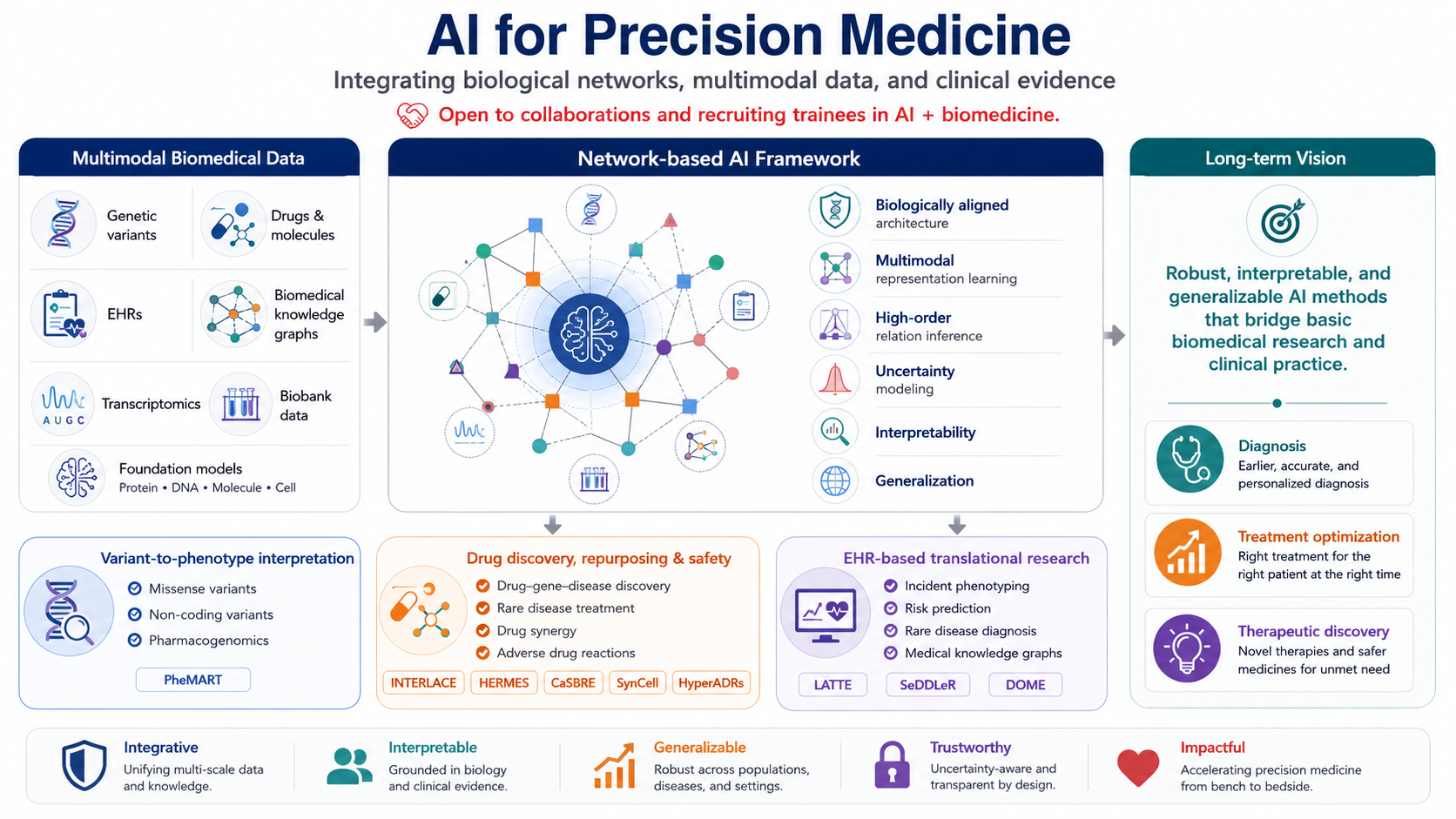
Our mission is to advance AI for precision medicine by integrating multi-scale biomedical data — including genomics, electronic health records, and biomedical knowledge graphs — to improve disease diagnosis, treatment optimization, and therapeutic discovery.

Previously, I was a Postdoctoral Research Fellow working with Professor Tianxi Cai at Harvard Medical School, and served as a data scientist at the Veterans Affairs Boston Healthcare System. I received my Ph.D. in Computer Science from Zhejiang University in 2020.

🚀 We are actively recruiting postdoctoral fellows, Ph.D. students, master’s students, and visiting researchers who are passionate about AI-enhanced translational biomedicine. If you are motivated to work at the frontier of AI and precision medicine, we warmly welcome you to join PAI Lab @ MBZUAI.


Research Interest

Our research focuses on developing AI-driven frameworks, particularly network-based AI models, to advance precision medicine by integrating multimodal biomedical data, including biomedical knowledge graphs, electronic health records (EHRs), foundational models, large-scale Biobank data, etc. We aim to understand the complex interplays among medications, genetic variants, and diseases (or phenotypes), specifically

  • Understand the consequences of genetic variants on clinical phenotypes, drug's therapeutic or adverse effects (e.g., PheMART)
  • Discover drug-gene-disease relationships for drug development, repurposing, and safety (e.g., INTERLACE, HERMES, CaSBRE)
  • EHR-based translational research, including incident phenotyping, disease risk prediction, rare disease diagnosing, and data-driven medical knowledge graph (e.g., LATTE, SeDDLeR, DOME)
Through these efforts, we are committed to shaping the future of precision medicine by creating robust, interpretable, and generalizable AI methodologies that bridge basic biomedical research and clinical practice.

Selected Publications

Phenotypic Prediction of Missense Variants via Deep Contrastive Learning
J. Wen, S. Zeng, ..., J. S. Liu, T. Cai
Nature Biomedical Engeering, acceptance, 2026

LATTE: Label-efficient Incident Phenotyping from Longitudinal EHR
J. Wen, J. Hou, C. Bonzel, Y. Zhao, ..., T. Cai
Patterns (Cell), 5(1), Cover Article, 2024

Multimodal Representation Learning for Predicting Molecule–Disease Relations
J. Wen, X. Zhang, E. Rush, ..., T. Cai
Bioinformatics, 39(2), btad085, 2023

DOME: Directional Medical Embeddings from EHR
J. Wen*, H. Xue*, E. Rush, ..., T. Cai
Journal of Biomedical Informatics, 104768, 2025

Integrating Knowledge Graph and Electronic Health Records for Drug Repurposing
J. Wen, N. Zhou, S., Cai ..., T. Cai
under submision, 2025

HOVER: Hyperbolic Video-Text Retrieval
J. Wen*, Y. Chen*, ..., R. Zimmermann
IEEE Transactions on Image Processing, 2025

Label-efficient Phenotyping for Long COVID Using EHR
C. Hong*, J. Wen*, H. Zhang*, ..., T. Cai
npj Digital Medicine, 8(1), 405, 2025

Heterogeneous Entity Representation for Medicinal Synergy Prediction
J. Wu*, J. Wen*, M. Yan*, ..., C. Chen
Bioinformatics, 41(1), btae750, 2025

Deep Learning from EHR to Identify RCC Recurrence
J. Hou*, J. Wen*, R. Bhattacharya, ..., T. Cai
ECMO conference, 35, S1027, 2024

SeDDLeR: Semi-supervised Double Deep Learning for Temporal Risk Prediction
I. E. Nogues*, J. Wen*, Y. Zhao, ..., T. Cai
Journal of Biomedical Informatics, 157, 104685, 2024

Weakly Semi-supervised Phenotyping Using EHR
I. E. Nogues, J. Wen, Y. Lin, ..., T. Cai, C. Hong
Journal of Biomedical Informatics, 134, 104175, 2022

SAMGEP: A Semi-supervised Adaptive Markov Gaussian Embedding Process for Phenotype Event Prediction
Y. Ahuja*, J. Wen*, ..., T. Cai
Scientific Reports, 12(1), 17737, 2022

CaSBRE: Causality-inspired Semi-supervised Biomedical Relation Extraction
S. Zeng*, J. Wen*, J. Du, ..., H. Wang
Under revision, 2025

Bayesian Uncertainty Matching for Unsupervised Domain Adaptation
J. Wen, N. Zheng, J. Yuan, Z. Gong, C. Chen
International Joint Conferences on Artificial Intelligenc (IJCAI), 2019

Exploiting Local Feature Patterns for Unsupervised Domain Adaptation
J. Wen, R. Liu, N. Zheng, Q. Zheng, Z. Gong, J. Yuan
AAAI Conference on Artificial Intelligence (AAAI), 2019
[PDF]

Unsupervised Representation Learning with Long-Term Dynamics for Skeleton-Based Action Recognition
J. Wen, N. Zheng, R. Liu, L. Long, J. Dai, Z. Gong
AAAI Conference on Artificial Intelligence (AAAI), 2018
[PDF]

Discriminative radial domain adaptation
Z. Huang, J. Wen, S. Chen, ..., N. Zheng
IEEE Transactions on Image Processing, 32, 1419-1431, 2023

Contrast-Reconstruction Representation Learning for Self-supervised Skeleton-Based Action Recognition
P. Wang, J. Wen, C. Si, ..., L. Wang
IEEE Transactions on Image Processing, 31, 6224–6238, 2022

Towards More General Loss and Setting in Unsupervised Domain Adaptation
C. Shui, R. Pu, G. Xu, J. Wen, ..., B. Wang
IEEE Transactions on Knowledge and Data Engineering, 35(10), 10140–10150, 2023

Generating Analysis-Ready Data for Real-World Evidence from EHR
J. Hou, R. Zhao, J. Gronsbell, ..., J. Wen, ..., T. Cai
Journal of Medical Internet Research, 25, e45662, 2023

A Two-layer Neural Circuit Controls Fast Forward Locomotion in Drosophila
Q. Zhao, X. Li, J. Wen, Y. He, ..., Z. Gong
Current Biology, 34(15), 3439–3453, 2024